A Meditation on Psalm 27
Throughout the Gospels, whenever we are given glimpses of Our Lady we see a woman who is profoundly attentive to the Word of God, a woman who is willing to listen to God’s words, to ponder them in her heart, and to surrender to the unfolding of those words in her life, no matter what the cost. Throughout her life on earth, Mary was given glimpses of the sacrifice of Christ on the cross, which is at once the source of all her joys and her deepest experience of sorrow, in which all other sorrows are enfolded. Like Mary, each of us is drawn into the unfolding of the Mystery of God’s Word in our own lives, especially through the liturgy. As we enter into this Mystery during Holy Week this year, it can be helpful to meditate on Our Lady’s attitude of loving surrender, participating in her Son’s saving act of obedience, and to ask her to be with us and to intercede for us as we surrender to and are transformed by this great Mystery.
Psalm 27 is a psalm of David which expresses both the very real anguish of suffering and opposition as well as the confident and joyful trust of one who is surrendered to God. The familiar opening lines express a truth so basic, yet so often forgotten: “The Lord is my light and my salvation; whom shall I fear? The Lord is the stronghold of my life; of whom shall I be afraid?” The truth is that the goodness of God is the origin and foundation of our lives and of all that is. His goodness and fidelity are always the walls of the stronghold that keeps us safe, and there is no power that can overcome His love for us. In the face of evil and destruction, chaos and death, Our Lord is light and salvation.
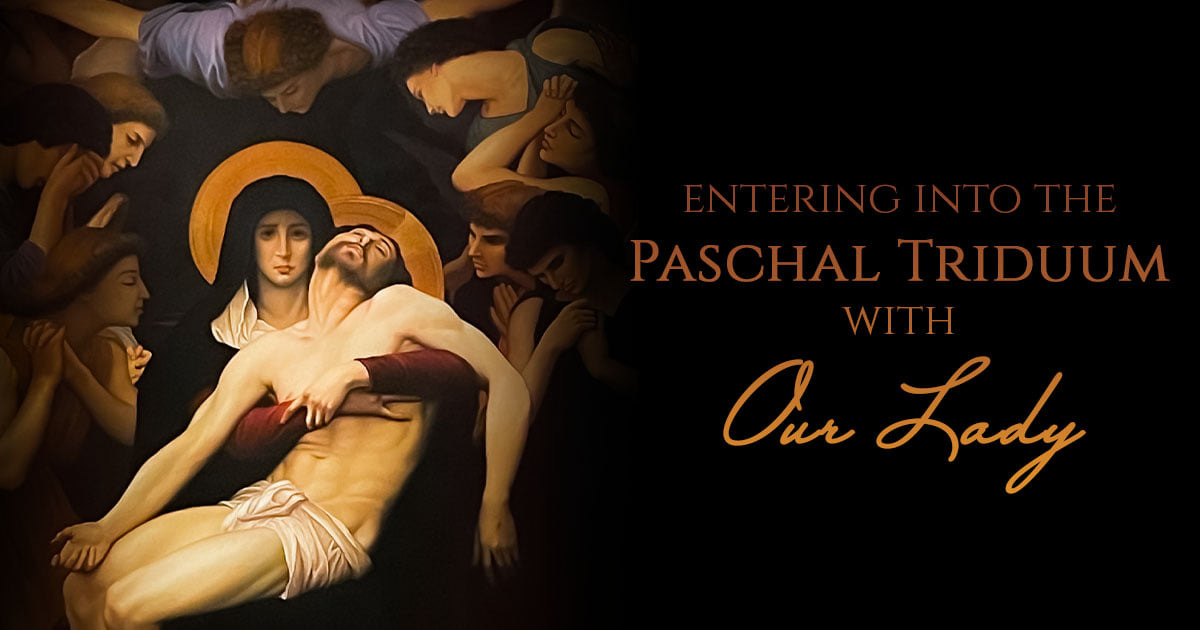
The psalm goes on to describe the evils that surround the psalmist, yet always from the perspective of this great hope. Verse three is reminiscent of the arrest of Our Lord in Gethsemane. When “hosts encamp against [Him]” He acts with great courage and trust, walking into the very heart of the “war” that is being waged against Him. Our Lady goes with Him, not physically into the prison, but through the perfect union of her heart and mind with His. She follows Him, seeking “one thing”: that she “may dwell in the house of the Lord all the days of [her] life” (verse 4). She seeks the Face of her Son, always beautiful even though it is disfigured and torn by our sins when He meets her on the road to Calvary, where He “will hide [her] in His under the cover of His tent” and “set [her] high upon a rock” (cf. verse 7; verse 5). As Mary lifts up her head to gaze on the Face of her Son, she is “lifted up above [the] enemies” around her, and in union with Christ, she “[offers] in His tent sacrifices with shouts of joy” (verse 6). It is hard to imagine joy in the midst of so much suffering, yet Our Lady always gave God her unreserved Yes in union with Jesus. After her initial “fiat” at the Annunciation, she reaffirmed and increased the ardor of that Yes when she saw her Son lying in a feeding trough in Bethlehem because no one would open their heart to give Him shelter and welcome. She made another act of faith and trust again when Joseph woke her up in the middle of the night to inform her that King Herod was seeking her Son’s life, when Simeon prophesied the contradiction He would endure and the sword that would pierce her soul also, and when the twelve-year-old Jesus explained to her why He had remained in the Temple after the Passover. All this time, Mary was pondering and learning, growing in the immaculate faith and trust that had been given her as God’s grace. Now on Calvary, Mary freely unites herself to her Son in His sacrifice, accepting, embracing, and affirming her Son’s mission among men as the ultimate witness of the transforming power of His love.
The next several verses express Mary’s dependence on the strength of God to sustain her in the face of all this evil. Although there is a graced joy in Our Lady’s surrender, she still suffers. She is acutely aware of the fragility of human nature and of the power of evil to destroy and mar what God created good and beautiful. But she also knows that what her Son says is true: “I am not alone, for the Father is with me” (Jn. 16:32). Likewise, she knows that she, together with her Son and the disciples whom He loves, is held in the Father’s hand, and no one is greater than the Father (cf. Jn. 10:29-30). This leads to the final verses of the psalm, which resound as a song of great hope and encouragement to us as they ascend to heaven with the words of Jesus as He gives up His spirit:
“I believe that I shall see the good things of the Lord
in the land of the living!
Wait for the Lord;
Be strong and let your heart take courage;
yes, wait for the Lord!”
-- Psalm 27:13-14
These words should ring in our ears as we wait in expectation for the Resurrection and the life of the world to come!