Who is St. Clare?
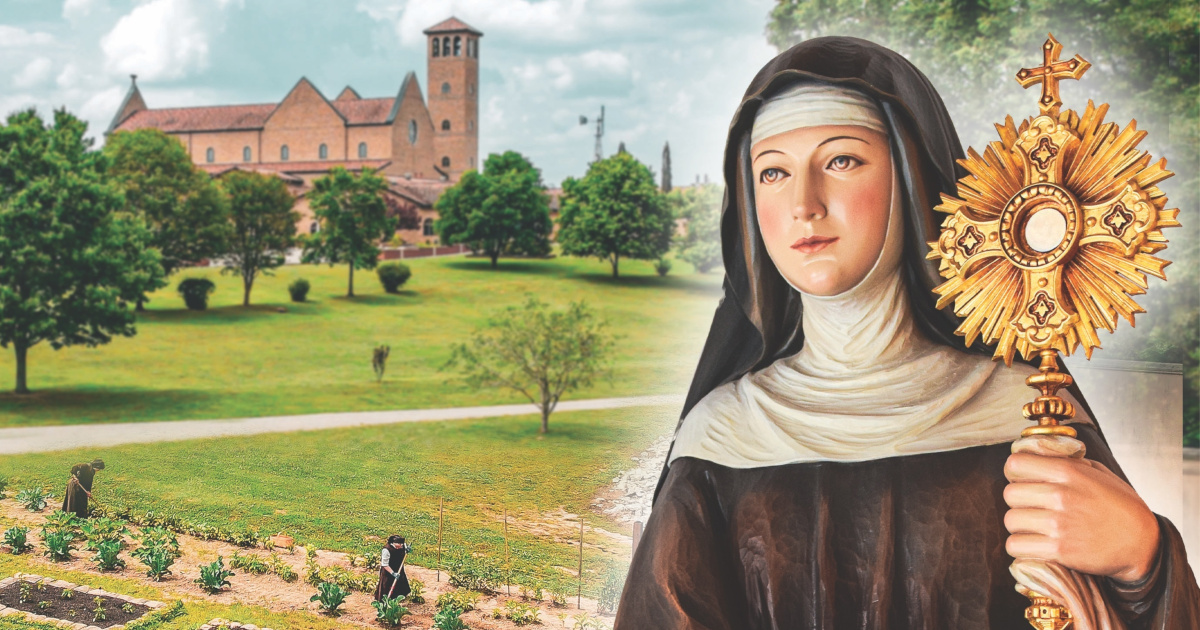
Saint Clare of Assisi was born on July 16, 1194 into a noble Italian family. In spite of her privileged beginnings, she knew hardship from an early age. She and her family fled into a social exile, taking refuge in the rival territory of Perugia due to the internal strife between classes in her own native town. Her childhood friends and acquaintances from this era of her life would later testify to her goodness, her faith and love for the poor.
Certainly Our Lord captivated her heart while she was still young. Her home was literally in the shadow of the city’s Cathedral where she first heard St. Francis preach. We can easily guess that St. Francis was the light God shed on St. Clare to show her her own vocation. She saw the form of life she so desired lived by this poor and riveting preacher. Her family would have known that something different was stirring in this young woman. She rejected every desirable suitor and family alliance that came with it. She even gave away her inheritance; a shocking and daring decision for an unmarried Lady.
Then, on Palm Sunday, March 18th, 1212, the 18 year-old Lady Clare secretly left her home by night and made her way to the little Chapel of the Portiuncula. A daring plan was necessary if she was to leave behind a life of nobility to follow Francis and thus begin a life “immersed in the poor and Crucified Christ,” as Pope St. John Paul would say of her. She set out on her journey just as the Church was beginning the commemoration of the Passion throughout the world.
Clare had her hair shorn that Palm Sunday by her spiritual father and was clothed in the tunic of the Lesser Brothers. St. Francis then led her to the nearby Benedictine Abbey where she spent a rather tumultuous few days. Her family was infuriated by her audacious choice and sought to win her back with flattery and then force. She stood her ground and in a gesture that would mirror her whole life’s goal, she clung to the altar cloth showing her family by her shorn head that she belonged irrevocably to the Lord.
Her unhindered generosity never wavered as she gave herself completely to “believing the Gospel as Francis showed her” to quote John Paul II again. Thus she blazed a path of sanctity, living a life of prayer imbued by the Gospel of Christ. Saint Clare and the many Poor Ladies that have preceded us gave themselves unreservedly to their Spouse, the Lord Jesus, living in faith in Him who would be their sufficiency, in Hope that He would fulfill all His Promises, and in ardent Charity, seeking the Face of the Crucified and union with Him in His Eucharistic Presence.
The PCPAs
The Poor Clare Nuns of Perpetual Adoration (P.C.P.A.) are a Pontifical Contemplative Order of Cloistered Nuns with the privilege of Solemn Exposition of the Most Blessed Sacrament, Solemn Vows and Papal Enclosure. We are part of the Second Order of Saint Francis of Assisi.
Our lives are consecrated to Adoration of Our Lord Jesus Christ in the Most Blessed Sacrament, solemnly exposed in the Monstrance in our Monastery Chapel. Each sister is privileged to have a daily hour of Adoration and also a few hours of night Adoration each week.
A Franciscan vocation is a call to follow in the footsteps of Jesus Christ, taking Him as one’s All! This is the aim of our spiritual life, handed down to us from St. Francis Deus Meus et Omnia! By embracing the vows of Poverty, Chastity and Obedience the heart is set free of earthly attachments to live the Gospel wholeheartedly as did our Holy Father Francis and Holy Mother Clare. Like them we are called to serve the Lord, the spouse of our souls, in joy and humility of heart.
Covenant Day
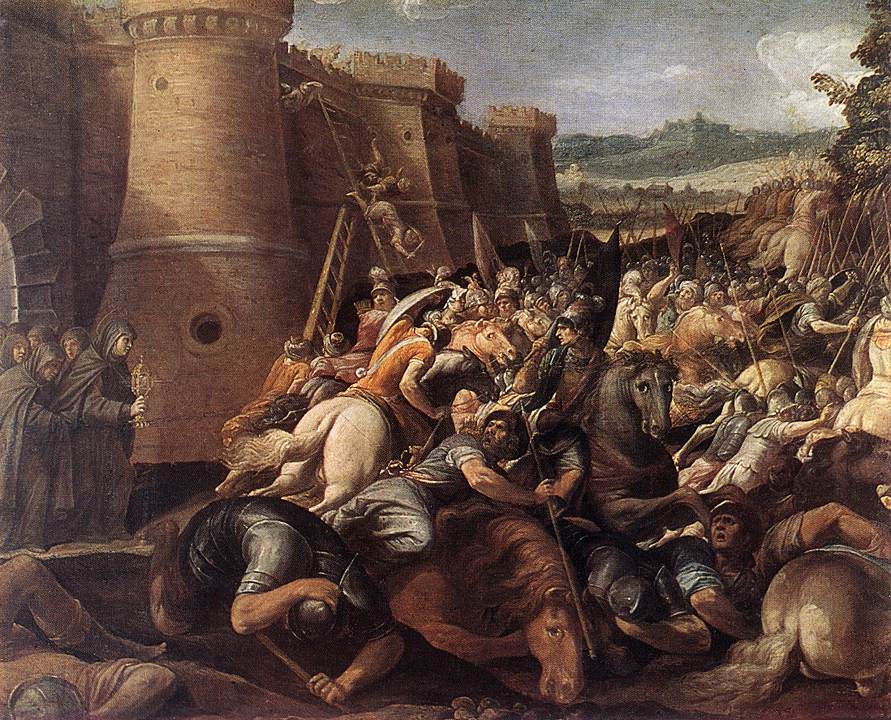
The tradition of Covenant Day has its roots in the events that took place in Assisi during the life of our Holy Mother St. Clare, when the monastery of San Damiano and the city of Assisi were attacked, first by Saracens, then later by an imperial army.
Although it almost seems as if we could begin the story with the words “Once upon a time, in a land far, far way,” in reality the events we celebrate on this beautiful day illuminate and deepen our insight into the mission and charism of this Shrine and Monastery. When San Damiano was attacked by the Saracens in the year 1230, our Holy Mother Clare’s long illness had already dramatically weakened her body. The Sisters at once ran to their Mother, full of fear, exclaiming that the invaders had already breached the enclosure. Calmly and with great confidence, our Holy Mother ordered the Sisters to bring her to the door of the refectory, along with the Blessed Sacrament, which was reserved in an ivory pyx. What follows is the account of her prayer as handed down to us in what is known as the Legend that was prepared in her honor for the occasion of her canonization:
“When she had thoroughly prostrated herself to the Lord in prayer, she said to her Christ with tears in her eyes, ‘Look, my Lord, do You wish to deliver into the hands of pagans Your defenseless servants whom You have nourished with Your own love? Lord, I beg You, defend these Your servants whom I am not able to defend at this time.’ Suddenly a voice from the mercy-seat of new grace, as if of a little child, resounded in her ears: “I will always defend you.’ ‘My Lord,’ she said, ‘please protect this city which for Your love sustains us.’ And the Lord said to her: ‘It will suffer many afflictions, but will be defended by My protection.’
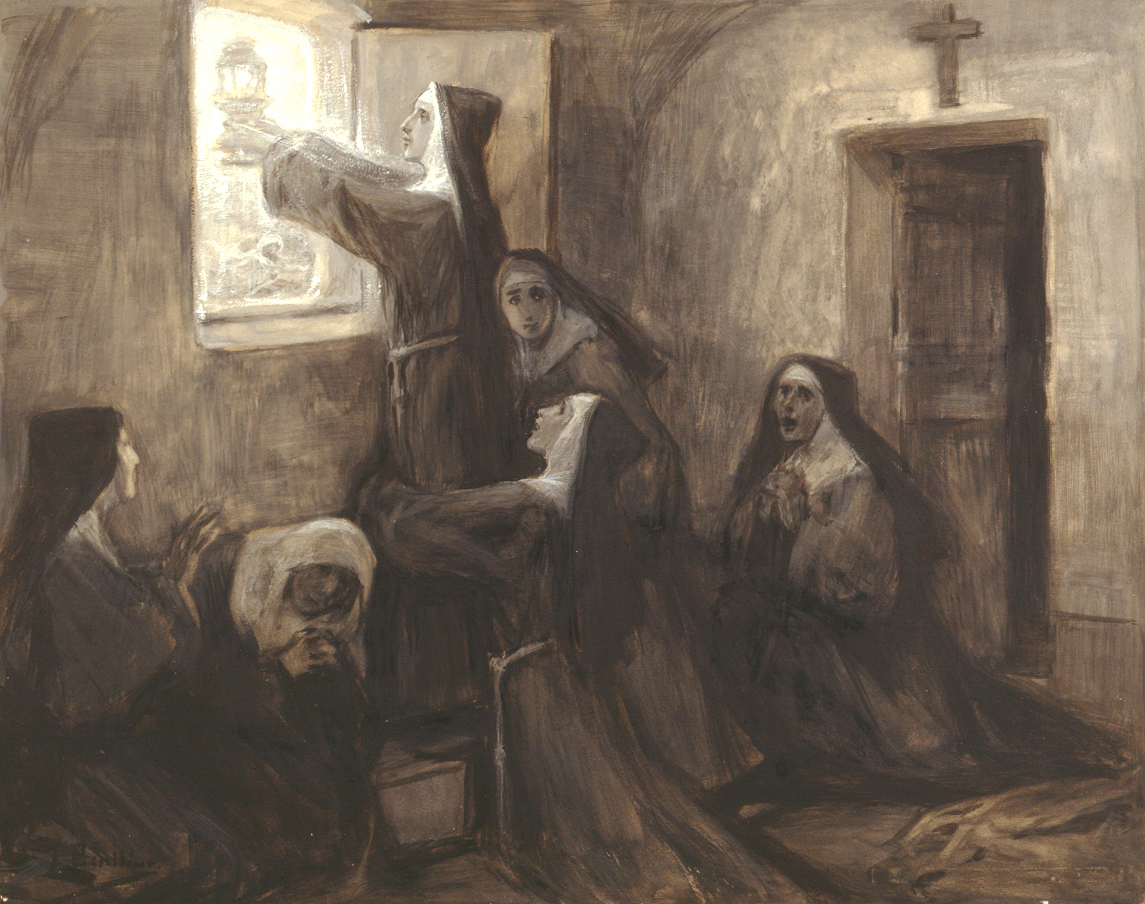
“Then the virgin, raising her tear-filled face, comforted the weeping sisters, saying: ‘My dear children, I guarantee, you will not suffer any harm. Just have confidence in Christ.’” The Legend tells us that immediately, the Saracens who had already scaled the walls fled, “driven away by the power of the one who was praying.”
This prayer of our Mother and by Our Lord’s response to her is a great source of encouragement and consolation for us Poor Clares. Also, there is much we can learn about St. Clare from this account: we see that her heart is filled with courage and compassion, even in the face of grave and imminent danger. We see the tenderness of her heart and her humility in her tears. We see her faith-filled surrender and trust in God in the face of her own weakness. Perhaps most significantly for us at the Shrine of the Most Blessed Sacrament, we see the kind of deep faith and confidence she had in Jesus Hostia. We learn from her that we can come before our Eucharistic Savior with all of our needs, our cares, our weakness and fragility. We come to Him Who became poor for our sake, living our poverty to the utmost in His Incarnation, in His sacrifice and surrender on the Cross, and in the Holy Eucharist.
From the Blessed Sacrament, our holy Mother heard the voice of a Child, promising sovereign protection in the face of violence and destruction. As our praying Mother was ill and weak herself, Our Lord used these three signs—the Sacred Host, the voice of the Child, and the prayer of a woman who was ill--to show in a threefold way that His power is made perfect in weakness. Here at the Shrine, we also take courage from the Divine Child Who leads us and loves us from His Eucharistic throne in the face of the enemies we meet in our world today. Thus, Covenant Day no longer appears as a mere tale come down to us from the far-off Middle Ages, but we see it for what it really is: a thanksgiving celebration of God’s love for us, His people and His beloved children.
“Who will separate us from the love of Christ? Shall tribulation, or distress, or persecution, or famine, or peril, or sword? …No, in all these things we are more than conquerors through Him who loved us. For I am sure that neither death, nor life, nor angels, nor principalities, nor things to come, nor powers, nor height, nor depth, nor anything else in all creation, will be able to separate us from the love of God in Christ Jesus our Lord” (Romans 8:35, 37-39).